Sunday, June 12, 2022

Huygens Principle: UNIZOR.COM - Physics4Teens - Waves - Phenomena of Light

Notes to a video lecture on http://www.unizor.com

Huygens Principle

The history of science knows two different approaches to understanding of what light is: corpuscular and wave theories. While the former was pioneered by such an authority as Isaac Newton and explained quite satisfactorily such properties of light as reflection, it was unable to properly explain some other observable properties, like changing the direction of light rays during refraction on a surface of glass or water.

The 17th century Dutch mathematician and physicist Cristiaan Huygens has suggested an interesting theory of light propagation that seems to explain properties of light from the wave theory viewpoint. This theory is called Huygens Principle or Huygens-Fresnel Principle, adding the name of French physicist Augustin Fresnel, who contributed a lot to develop this theory.

The first point of Huygens was that light is longitudinal mechanical oscillations of some substance called ether (or aether) that exists everywhere and penetrates everything, including vacuum in the outer space. These oscillations are analogous to sound waves in the air - periodic change of density of the air.
Based on this idea, Huygens introduced a principle that states: when any wave front (light waves, sound waves, water waves etc.) reaches any point in whatever environment it propagates, it becomes a source of new waves propagating from this point in all directions.

To better understand the logic behind this principle, imagine two rooms with a door in between them. The music is played in one room, while you are sitting in another. You hear the music, as it comes from the door, not from the original player in another room. The reason is that the sound propagates in all direction from the original source, reaches the door and propagates from the door in all directions, as if it is produced inside the door. All other sounds from all other directions you cannot hear, they are absorbed by the walls. So, the door plays a role of a secondary source of sound.

We will use the term "wave front" to characterize a set of points reached by light emitted by some source at the same time. If the source of light is a point and light propagates in the uniform environment, the wave front is spherical; if the source of light is a straight line, the wave front in the uniform environment is cylindrical; if the source of light is a flat plane, the wave front in the uniform environment is a flat plane.
Below picture illustrates the Huygens Principle for two kinds of waves - flat plane wave front and spherical wave front represented in two-dimensional section.

Let's assume that at time t the wave front is a certain surface in space (sphere, cylinder, plane or any complex surface).
The Huygens Principle states that at any time every point on this wave front emits secondary spherical waves of light around it. During the next small time period Δt the light emitted by each point will reach a surface of a tiny sphere of radius r=c·Δt around this point, where c is a speed of light. Then the wave front at time t+Δt is a surface enveloping all these tiny spheres.
That means that the wave front at time t+Δt is tangent to all tiny spheres of radius r=c·Δt around each point on the wave front at time t.

In the uniform environment all tiny spheres around all points on the wave front at time t will have the same radius and the wave front at time t+Δt will resemble the wave front at time t, as seen on the picture above.

In the non-uniform environment, when the speed of light is not the same for all points on the wave front, the picture is different. The tiny spheres around different points on the wave front will have different radius, and the new wave front will have a different shape, like on the picture below.

When the radius r=c·Δt of a secondary spherical wave of light is different for different points of a wave front at time t because the speed of light c is different, the wave front at time t+Δt might not resemble original wave front.
It usually happens, when the light goes from one transparent substance into another, like from air to glass.

The retaining of the shape of the wave front in case of a uniform environment might need some explanation.
Let's consider the propagation of light in details for a flat wave front, when the speed of light is the same at all points on the wave front.
Consider two neighboring points on the wave front (green) and light rays emitted by them (blue and red).

The rays of light perpendicular to a wave front (thick blue rays on the picture) go always in the direction of the wave front propagation.
The symmetrical red rays emitted by two neighboring points on the wave front at an angle to the wave front propagation towards each other superimpose each on the other and, as a result, direct the combined rays also in the direction of the wave front propagation.
For the spherical or cylindrical shape of the wave front the considerations are similar.
That's why, according to Huygens Principle, the light emitted by any source retains the shape of the wave front in the uniform environment.

We should note that an explanation above is very primitive and requires some sophisticated mathematics to support. Many scientists contributed to this process, and the Huygens Principle was tested both theoretically and experimentally. Not always it was firmly confirmed, but for our purposes it's a good tool to explain certain light phenomena, which will be addressed in the following lectures.

As an example of one particular wave propagation phenomena, not properly explainable by a corpuscular theory and where the Huygens Principle shines, consider a ray of parallel light rays, emitted by a flat plane source, going through a small opening and falling on the screen.
According to a corpuscular theory, the screen should show exactly the same light spot as the opening is. Experiments show, however, that the light spot on the screen is wider than the opening with intensity of the light spot on a screen rapidly diminishing, as we go further from the center of a spot.

Picture below illustrates this phenomena from the position of Huygens Principle.

Since every point of a flat wave front that has reached the opening is a source of secondary waves emitted in all directions, the light after the opening is widening with the brightest part along the previous direction of the light rays, but surrounding space also obtaining its share of light, diminishing as the distance from the original direction increases.

Actually, the above picture illustrates even more than just gradual dissipation of light. It illustrates the phenomena of diffraction, which will be considered later.

Finally, the presentation of the Huygens Principle would not be complete without mentioning its drawbacks.

1. Ether does not exist, as experiments show. It does not mean that light is not oscillations, it's just not mechanical oscillation of some substance, but oscillations of electro-magnetic field.

2. Propagation of light along a straight line is not properly explained in the framework of Huygens Principle; the above explanation of combination of neighboring symmetrical rays is far from rigorous.

3. Huygens Principle cannot explain the polarization of light.

4. Photoelectric effect cannot be explained within the framework of Huygens Principle.

5. Backward propagation of light seems to follow from the Huygens Principle, which is not the way light goes.

Regardless of these drawbacks, Huygens has introduced an extremely important idea that light is oscillations. This led to a substantial flow of discoveries and theories.

Monday, June 6, 2022

A few exams were added to Geometry part of the "Math 4 Teens" course on UNIZOR.COM. I strongly recommend not to bypass exams, if they are available. Good luck!

Monday, April 25, 2022

A new exam to cover a topic "System of General Inequalities" has been released to UNIZOR.COM - Math 4 Teens - Algebra. It contains six multiple choice problems. Highly recommended for those who seek Knowledge.

1. What is a solution to the following inequality?
(x2 + y2 −16)·(x2 + y2 − 36) < 0

2. What is the area S of the part of a coordinate plane defined by the following inequality?
(x2 + y2 − 25)·(x2 + y2 − 49) > 0

3. What is the area S of the part of a coordinate plane defined by the following system of inequalities?
x2 + y2 − 4 < 0
y − x < 0


4. What is the perimeter P of the part of a coordinate plane defined by the following system of inequalities?
x2 − 4 < 0
y2 − 16 < 0


5. What is the perimeter P of the part of a coordinate plane defined by the following system of inequalities?
x2 + y2 − 9 < 0
x + y < 0


6. The part of a coordinate plane is defined by the following inequalities?
x2 + y2 − R2 < 0
y − |x| < 0

What is the value of parameter R, if the area of thus defined part of a coordinated plane equals to 48π?

Sunday, April 24, 2022

Sequence Problem

PROBLEM
Let
X0 = 0,
X1 = 1
and general formula for this sequence is
Xn+2 = 3·Xn+1 − 2·Xn
Prove that
Yn = Xn2 + 2(n+2) are exact squares of some natural numbers.
PROOF
Let's prove by induction that Xn = 2n − 1
(a) For n=0 this is true since x0 = 20 − 1 = 0, as set above
(b) For n=1 this is true since x1 = 21 − 1 = 1, as set above
(c) Assume that Xk = 2k − 1 and Xk+1 = 2k+1 − 1
and, based on that, calculate Xk+2:
Xk+2 = 3·Xk+1 − 2·Xk =
= 3·(2k+1 − 1) − 2·(2k − 1) =
= 3·2k+1 − 3 − 2·2k + 2 =
= 3·2k+1 − 2k+1 − 1 =
= 2·2k+1 − 1 =
= 2k+2 − 1

which corresponds to a formula that we are trying to prove.

Using this general formula for Xk = 2k − 1, we will prove that
Yn = Xn2 + 2(n+2) are exact squares of some natural numbers.
Indeed,
Yn = (2n − 1)2 + 2(n+2) =
= 22n − 2·2n + 1 + 2(n+2) =
= 22n − 2·2n + 1 + 4·2n =
= 22n + 2·2n + 1 =
= (2n + 1)2

Exponential equation

4x + 6x = 9x
(2·2)x + (2·3)x = (3·3)x
Since (2·3)x never equals to zero, we can divide both sides of this equation by it without losing any solutions.
The result is
(2/3)x + 1 = (3/2)x
Let y=(2/3)x
Then y + 1 = 1/y
Since y is always positive, we can multiply both sides by it getting an equivalent equation
y² + y − 1 = 0
Solutions to this quadratic equation are
y1,2 = (−1 ± √5)/2
Therefore, x1,2 = log2/3[(−1 ± √5)/2]

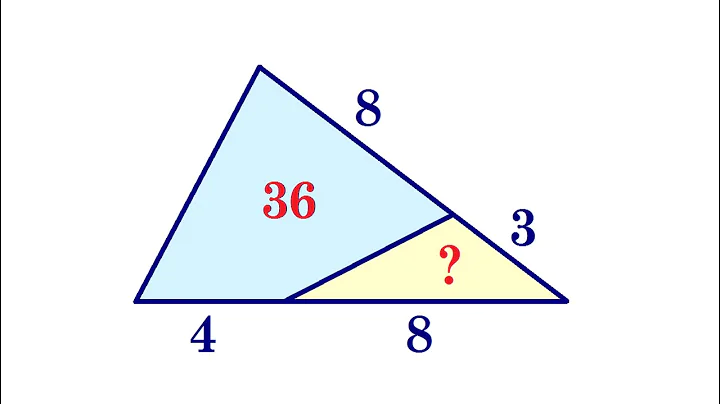
Simple problem on an area of a triangle

Add two altitudes towards the bases of both triangles (big and small), one H from the top of the big triangle onto a side of 8+4=12 length and another h from the top of the small triangle onto a side of 8 length.
Let the unknown area of a small triangle be x.
Then
(a) 12·H = x + 36
(b) 8·h = x
(c) H/h = (8+3)/3
This is a simple system of three equations with three unknowns.
Divide the first equation (a) by the second (b):
(12·H)/(8·h) = (x + 36)/x
or
(d) (3/2)·(H/h) = 1 + 36/x
Using the third equation (c) that states that H/h = 11/3, express (d) as
(3/2)·(11/3) = 1 + 36/x
or
11/2 = 1 + 36/x
or
9/2 = 36/x
from which
x = 8

Saturday, March 26, 2022

Systems of Quadratic Equations: UNIZOR.COM - Math4Teens - Algebra - Equa...

Notes to a video lecture on http://www.unizor.com

Examples of Systems
of Quadratic Equations


We will restrict solutions to real numbers only.

Example 1
x·y = −12
x·z = −15
y·z = 20

Solution A
From the third equation:
z = 20/y
Substitute it to the second, getting a system of two equations with two unknowns:
x·y = −12
x·20/y = −15
From the second equation:
y = −x·20/15 = −x·4/3
Substitute into the first equation:
−x·x·4/3 = −12
Solving it for x:
x² = 9
One root is x1=3, another is x2=−3.
Case x1=3:
y1 = −4
z1 = −5
Case x2=−3:
y2 = 4
z2 = 5

Solution B (more clever)
Obviously, none of the unknowns equals to zero.
Multiply all three equations, getting
(x·y·z)² = 3600
Therefore, we have two cases:
x·y·z = 60
or
x·y·z = −60
Case x·y·z = 60
Divide it by each given equation, getting
z1 = −60/12 = −5
y1 = −60/15 = −4
x1 = 60/20 = 3
Case x·y·z = −60
Divide it by each given equation, getting
z2 = 60/12 = 5
y2 = 60/15 = 4
x2 = −60/20 = −3

Answer
There are two solutions to this system:
(x1,y1,z1)=(3,−4,−5)
(x2,y2,z2)=(−3,4,5)

Checking
ALWAYS PERFORM CHECKING OF ALL SOLUTIONS


Example 2
(x+2)·(y+2) = −10
(x+y)·(x·y−3) = 15

Solution
Both equations are of the second degree, so directly resolving one of them for, say, y in terms of x and substituting into another might be too complex.
Notice the symmetry between unknown variables x and y.
If, instead of x, we use y and, instead of y, use x, we will have the same equation.
In cases like this it might be useful to introduce new variables a=x+y and b=x·y.
Transform these equations:
(x+2)·(y+2) =
= x·y+2(x+y)+4 = −10

(x+y)·(x·y−3) =
= (x+y)·(x·y)−3(x+y) = 15

We can assign two new unknown variables a=x+y and b=x·y to obtain the following quadratic system of two equation with one of them being of the first degree
b + 2a + 4 = −10
a·b − 3a = 15
From the first linear equation we can get b in terms of a and substitute into a second equation getting a quadratic equation with one variable:
b = −2a − 14
a·(−2a−14) − 3a = 15
Simplifying the above:
2a² + 17a + 15 = 0
This quadratic equation has roots
a1 = −1
a2 = −15/2
Each of these solutions should be considered separately to get x and y.

Case a = −1.
b = −2a−14 = −12
This leads us to a quadratic system
x + y = −1
x·y = −12
Expressing y in terms of x from the first equations and substituting into the second:
y = −1 − x
x·(−1− x) = −12
x² + x − 12 = 0
x1 = −4; x2 = 3
y1 = 3; y2 = −4
(notice the symmetry, mentioned in the beginning)

Case a = −15/2.
b = −2a−14 = 1
This leads us to a quadratic system
x + y = −15/2
x·y = 1
Expressing y in terms of x from the first equations and substituting into the second:
y = −15/2 − x
x·(−15/2 − x) = 1
x² + (15/2)·x + 1 = 0
2x² + 15x + 2 = 0
x3 = (−15+√209)/4;
x4 = (−15−√209)/4

y3 = (−15−√209)/4;
y4 = (−15+√209)/4

(notice the symmetry, mentioned in the beginning)

Answer
There are 4 (x,y) pairs of solutions:
−4, 3
3, −4
(−15+√209)/4, (−15−√209)/4
(−15−√209)/4, (−15+√209)/4


Checking
ALWAYS PERFORM CHECKING OF ALL SOLUTIONS


Example 3
x·y² − x − 2y = −2
x·y + y = 2

Solution
The first equation can be transformed to an equivalent
x·(y²−1) − 2(y−1) = 0
x·(y−1)·(y+1) − 2(y−1) = 0
(y−1)·(x·y+x−2) = 0
This allows to split a problem in two:
Case y−1=0, that is y=1
From the second equation of the system x·y+y=2
we obtain x for y=1:
x·1 + 1 = 2
x = 1
So, the first solution to our system is
(x1=1, y1=1)
Case x·y+x−2=0
Let's subtract this from the second equation x·y+y=2
The result is
y − x = 0, that is y = x
which converts the second equation into a quadratic one
x² + x − 2 = 0
Its roots are:
x2 = −2
from which y2=x2=−2 and
x3 = 1
from which y3=x3=1
which we already obtained in the previous case.

Answer
(x1=1, y1=1)
(x2=−2, y2=−2)

Checking
DON'T FORGET TO CHECK YOUR SOLUTIONS

Example 4
1/(x+y) + 1/(x−y) = 36/5
(x+y)² + (x−y)² = 13/18

Solution
First simplification can be achieved by introducing two new variables:
u = x+y
v = x−y
This leads to a new simpler system of equations:
1/u + 1/v = 36/5
u² + v² = 13/18
The first on can be rewritten as:
(u+v)/(u·v) = 36/5
The second one can be rewritten as:
u² + 2u·v + v² − 2u·v = 13/18
or
(u+v)² − 2u·v = 13/18
Another pair of variables can simplify it even further:
p = u+v
q = u·v
In terms of these variables the system looks like
p/q = 36/5
p² − 2q = 13/18
Now we can express q as a function of p and substitute it the second equation:
q = 5·p/36
p² − 2·5·p/36 − 13/18 = 0
So, we have a plain quadratic equation for p:
p² − (5/18)p − 13/18 = 0
It has 2 roots: p1=1 (easy to guess) and p2=−13/18 (because the product of these roots must be equal to a free member of the equation).
Correspondingly,
q1 = 5/36
q2 = −(13/18)·(5/36) = −65/648
Since we have defined p=u+v and q=u·v, values u and v must be the roots of the quadratic equation w² −p·w + q = 0
Case (p,q)=(1,5/36)
w² − w + 5/36 = 0
Roots are:
w1=1/6, w2=5/6
Therefore, we have two cases:
(u,v)=(5/6, 1/6) and
(u,v)=(1/6, 5/6)
In the first case we can have a system of equations for x and y as
x+y = u = 5/6
x−y = v = 1/6
Solution to this linear system is:
x = 1/2, y = 1/3
In the second case we can have a system of equations for x and y as
x+y = u = 1/6
x−y = v = 5/6
Solution to this linear system is:
x = 1/2, y = −1/3
Case (p,q)=(−13/18,−65/648)
w² + (13/18)·w − 65/648 = 0
Roots of this equation, w1 and w2 will give values for u and v:
(u,v)=(w1, w2) and
(u,v)=(w2, w1)
From these two pairs of u and u we will derive x and y.
Getting exact values in this case we leave to those who are not afraid of cumbersome calculations.

Checking
JUST DON'T FORGET TO CHECK YOUR SOLUTION.