Notes to a video lecture on http://www.unizor.com
Algebra+ 08 - Fibonacci
Note
We will use both terms average and mean interchangeably, but usually with proper qualification, like geometric mean or harmonic average.
Problem A
The Fibonacci sequence F(n) for integer n=0,1,2,3... is a sequence of numbers that starts with
F(0)=0, F(1)=1
and satisfies the rule for any integer n≥0:
F(n) + F(n+1) = F(n+2)
which results in
F(2)=F(0)+F(1)=0+1=1
F(3)=F(1)+F(2)=1+1=2
F(4)=F(2)+F(3)=1+2=3
F(5)=F(3)+F(4)=2+3=5
F(6)=F(4)+F(5)=3+5=8
F(7)=F(5)+F(6)=5+8=13
etc.
Derive formula for the Fibonacci sequence.
Hint A
Prove that if the following equation
Xn + Xn+1 = Xn+2
is true for n=0, it's true for any other positive integer n.
Solution A
Let's prove the statement in the Hint A above by using mathematical induction.
For n=0 it's assumed to be true.
Assume, it's true for some n, that is assume that
Xn + Xn+1 = Xn+2
is true for some n.
We have to prove that it's true for n+1, that is we have to prove that
Xn+1 + Xn+2 = Xn+3
Indeed,
Xn+1 + Xn+2 =
= X·(Xn + Xn+1) =
= [use assumption for n] =
= X·Xn+2 = Xn+3
The formula
Xn + Xn+1 = Xn+2
looks very much like the definition for Fibonacci sequence
F(n) + F(n+1) = F(n+2)
But are there any X that satisfy the initial conditions for Fibonacci sequence
F(0)=0, F(1)=1?
If yes, the solution for a formula describing the sequence would be solved.
The answer is YES.
First of all, let's find value(s) of X for n=0, that is let's solve the equation
Xn + Xn+1 = Xn+2
for n=0.
X0 + X1 = X2 or
1 + X = X2 or
X2 − X − 1 = 0
It has two solutions
X1,2 = (1 ± √1+4)/2 =
= (1 ± √5)/2
Both of these values, if used in the expression
Xn + Xn+1 = Xn+2
transform it into identity for any natural n because they do it for n=0 and because we have proven above by induction that, if true for n=0, it's true for all natural n.
Let's check if a condition
F(n) + F(n+1) = F(n+2)
is satisfied for F1(n)=X1n and F2(n)=X2n.
For X1:
F1(n) = [(1+√5)/2]n
F1(n+1) = [(1+√5)/2]n+1
F1(n) + F1(n+1) =
= [(1+√5)/2]n+[(1+√5)/2]n+1=
= [(1+√5)/2]n·[1+(1+√5)/2] =
= [(1+√5)/2]n·[(3+√5)/2] =
= [(1+√5)/2]n·[(6+2√5)/4] =
= [(1+√5)/2]n·[(1+2√5+5)/4] =
= [(1+√5)/2]n·[(1+√5)/2]2 =
= [(1+√5)/2]n+2 = F1(n+2)
Similarly, the condition
F(n) + F(n+1) = F(n+2)
is satisfied for X2, we omit analogous calculations.
While the main condition of Fibonacci sequence, connecting any element with a sum of two preceding ones, is satisfied for both variants above, initial conditions for Fibonacci sequence
F(0)=1, F(1)=1
are not yet satisfied.
Notice that if
X1n + X1n+1 = X1n+2 and
X2n + X2n+1 = X2n+2 then
p·X1n+q·X2n +
+ p·X1n+1+q·X2n+1 =
= p·X1n+2+q·X2n+2
for any p and q.
So, the obvious suggestion is to find such p and q that a function
F(n) = p·X1n+q·X2n
where X1=(1+√5)/2 and
X2=(1−√5)/2, would satisfy the initial condition as well as the formula connecting the next sequence value with a sum of two preceding ones.
Condition F(0)=0 gives
p·X10+q·X20 = 0
Any non-zero number raised to the power of 0 gives 1. So, this condition is equivalent to
p + q = 0
Condition F(1)=1 gives
p·X11+q·X21 = 1
Any non-zero number raised to the power of 1 is itself. So, this condition is
p·X11 + q·X21 = 1 or
p·(1+√5)/2 + q·(1−√5)/2 = 1
Now we have a system of two linear equations with two unknowns p and q.
From the first equation
q = −p
Substitute it to the second equation:
p·(1+√5)/2 − p·(1−√5)/2 = 1
from which follows
p = 1/√5 and
q = −1/√5
The final formula for Fibonacci sequence is, therefore,
F(n) = (1/√5)·[(1+√5)/2]n −
− (1/√5)·[(1−√5)/2]n
Sunday, June 30, 2024


Saturday, June 29, 2024
Algebra+ 07 - Averages: UNIZOR.COM - Math+ & Problems - Algebra
Notes to a video lecture on http://www.unizor.com
Algebra+ 07
Note
We will use both terms average and mean interchangeably, but usually with proper qualification, like geometric mean or harmonic average.
Problem A
Given that a fence around a rectangular field should have the length L, what should the sides of this field be to maximize the field's area?
What is the maximum area of a field in this case?
Hint
Arithmetic mean (average) of two positive real numbers is not less than their geometric mean (average).
These averages are equal only if the participating numbers are equal.
Answer
All sides must be equal to L/4 to form a square field.
The area will then be L²/16.
Problem B
In lecture UNIZOR.COM - "Math 4 Teens" - "Math Concepts" - "Induction" - "Averages" we have proven that arithmetic mean of N positive real numbers is greater or equal to their geometric mean:
(X1+X2+...+XN)/N ≥
≥ (X1·X2·...·XN)1/N
Prove now that geometric mean of N positive numbers is greater or equal to their harmonic mean:
(X1·X2·...·XN)1/N ≥
≥ N/(1/X1+1/X2+...+1/XN)
Hint B
Use the theorem about arithmetic and geometric means mentioned above for numbers 1/X1, 1/X2 etc.
Problem C
Prove that quadratic mean of N positive numbers is greater or equal to their arithmetic mean:
sqrt[(X12+X22+...+XN2)/N] ≥
≥ (X1+X2+...+XN)/N
where sqrt is a square root function.
Hint C
The proof in general case is similar to the one with only a few numbers.
Let's analyze the situation with only 2 components.
Start from what's necessary to prove
sqrt[(a2+b2)/2] ≥ (a+b)/2
Since all numbers are positive, get rid of sqrt function by raising both sides of an inequality to the power of 2 and apply invariant transformations.
(a2+b2)/2 ≥ (a+b)2/4
2·(a2+b2) ≥ a2+2a·b+b2
a2+b2−2a·b ≥ 0
(a−b)2 ≥ 0
which is obvious, and all transformations are reversible.
Therefore, the proof is to derive the required inequality by reversed transformations from the obviously correct last inequality.
Let's illustrate the same approach for 4 numbers.
sqrt[(a2+b2+c2+d2)/4] ≥
≥ (a+b+c+d)/4
Since all numbers are positive, get rid of sqrt function by raising both sides of an inequality to the power of 2.
(a2+b2+c2+d2)/4 ≥
≥ (a+b+c+d)2/16
Use the invariant transformations:
4·(a2+b2+c2+d2) ≥
≥ a2+b2+c2+d2+
+2ab+2ac+2ad+
+2bc+2bd+2cd
3·(a2+b2+c2+d2) ≥
≥ 2ab+2ac+2ad+
+2bc+2bd+2cd
(a−b)2+(a−c)2+(a−d)2+
+(b−c)2+(b−d)2+(c−d)2 ≥ 0
which is obvious, and all transformations are reversible.
Therefore, the proof is to derive the required inequality by reversed transformations from the obviously correct last inequality.
Proof C
Given N positive real numbers Xi (i∈[1,N]).
Notice that
[Σ1≤ i ≤NXi]2 =
= Σ1≤ i ≤NXi2 +
+ Σ1≤ i < j ≤N2XiXj
Let's start from the obvious
Σ1≤ i < j ≤N(Xi−Xj)2 ≥ 0
From this follows:
(N−1)·Σ1≤ i ≤NXi2 −
− Σ1≤ i < j ≤N2XiXj ≥ 0
Move products of different numbers to the right side of the inequality and add the sum of the squares of all numbers to both sides.
N·Σ1≤ i ≤NXi2 ≥
≥ Σ1≤ i ≤NXi2 +
+ Σ1≤ i < j ≤N2XiXj
Transform the right side into a square of the sum of all numbers.
N·Σ1≤ i ≤NXi2 ≥
≥ [Σ1≤ i ≤NXi]2
Summary
Harmonic mean (HM)
N / [Σi∈[1,N]1/Xi]
is less or equal to
geometric mean (GM)
[Πi∈[1,N]Xi]1/N
which is less or equal to
arithmetic mean (AM)
[Σi∈[1,N]Xi] / N
which is less or equal to
quadratic mean (QM)
sqrt{[Σi∈[1,N]Xi2] / N}
HM ≤ GM ≤ AM ≤ QM
Algebra+ 07
Note
We will use both terms average and mean interchangeably, but usually with proper qualification, like geometric mean or harmonic average.
Problem A
Given that a fence around a rectangular field should have the length L, what should the sides of this field be to maximize the field's area?
What is the maximum area of a field in this case?
Hint
Arithmetic mean (average) of two positive real numbers is not less than their geometric mean (average).
These averages are equal only if the participating numbers are equal.
Answer
All sides must be equal to L/4 to form a square field.
The area will then be L²/16.
Problem B
In lecture UNIZOR.COM - "Math 4 Teens" - "Math Concepts" - "Induction" - "Averages" we have proven that arithmetic mean of N positive real numbers is greater or equal to their geometric mean:
(X1+X2+...+XN)/N ≥
≥ (X1·X2·...·XN)1/N
Prove now that geometric mean of N positive numbers is greater or equal to their harmonic mean:
(X1·X2·...·XN)1/N ≥
≥ N/(1/X1+1/X2+...+1/XN)
Hint B
Use the theorem about arithmetic and geometric means mentioned above for numbers 1/X1, 1/X2 etc.
Problem C
Prove that quadratic mean of N positive numbers is greater or equal to their arithmetic mean:
sqrt[(X12+X22+...+XN2)/N] ≥
≥ (X1+X2+...+XN)/N
where sqrt is a square root function.
Hint C
The proof in general case is similar to the one with only a few numbers.
Let's analyze the situation with only 2 components.
Start from what's necessary to prove
sqrt[(a2+b2)/2] ≥ (a+b)/2
Since all numbers are positive, get rid of sqrt function by raising both sides of an inequality to the power of 2 and apply invariant transformations.
(a2+b2)/2 ≥ (a+b)2/4
2·(a2+b2) ≥ a2+2a·b+b2
a2+b2−2a·b ≥ 0
(a−b)2 ≥ 0
which is obvious, and all transformations are reversible.
Therefore, the proof is to derive the required inequality by reversed transformations from the obviously correct last inequality.
Let's illustrate the same approach for 4 numbers.
sqrt[(a2+b2+c2+d2)/4] ≥
≥ (a+b+c+d)/4
Since all numbers are positive, get rid of sqrt function by raising both sides of an inequality to the power of 2.
(a2+b2+c2+d2)/4 ≥
≥ (a+b+c+d)2/16
Use the invariant transformations:
4·(a2+b2+c2+d2) ≥
≥ a2+b2+c2+d2+
+2ab+2ac+2ad+
+2bc+2bd+2cd
3·(a2+b2+c2+d2) ≥
≥ 2ab+2ac+2ad+
+2bc+2bd+2cd
(a−b)2+(a−c)2+(a−d)2+
+(b−c)2+(b−d)2+(c−d)2 ≥ 0
which is obvious, and all transformations are reversible.
Therefore, the proof is to derive the required inequality by reversed transformations from the obviously correct last inequality.
Proof C
Given N positive real numbers Xi (i∈[1,N]).
Notice that
[Σ1≤ i ≤NXi]2 =
= Σ1≤ i ≤NXi2 +
+ Σ1≤ i < j ≤N2XiXj
Let's start from the obvious
Σ1≤ i < j ≤N(Xi−Xj)2 ≥ 0
From this follows:
(N−1)·Σ1≤ i ≤NXi2 −
− Σ1≤ i < j ≤N2XiXj ≥ 0
Move products of different numbers to the right side of the inequality and add the sum of the squares of all numbers to both sides.
N·Σ1≤ i ≤NXi2 ≥
≥ Σ1≤ i ≤NXi2 +
+ Σ1≤ i < j ≤N2XiXj
Transform the right side into a square of the sum of all numbers.
N·Σ1≤ i ≤NXi2 ≥
≥ [Σ1≤ i ≤NXi]2
Summary
Harmonic mean (HM)
N / [Σi∈[1,N]1/Xi]
is less or equal to
geometric mean (GM)
[Πi∈[1,N]Xi]1/N
which is less or equal to
arithmetic mean (AM)
[Σi∈[1,N]Xi] / N
which is less or equal to
quadratic mean (QM)
sqrt{[Σi∈[1,N]Xi2] / N}
HM ≤ GM ≤ AM ≤ QM
Thursday, June 27, 2024
Geometry+ 10: UNIZOR.COM - Math+ & Problems - Geometry
Notes to a video lecture on http://www.unizor.com
Geometry+ 10
Problem A
Given two parallel lines and a segment AB on one of them. Using only a straight line ruler, increase the length of segment AB by a factor of N.
In other words, find a point B' on the same line as AB such that the length of AB' is N times greater than the length of AB.
Solution A
Let's repeat the doubling of a segment, explained in the previous lecture Geometry 09 as Problem C.
Assume, AB is on the lower parallel line as on the picture below.

Choose any segment CD along the upper parallel line and divide it in halves by point P, as described in the Problem B of lecture Geometry 09.
Connect A and C, connect B and P. Lines AC and BP intersect at some pointM (if they don't and happened to be parallel, choose a longer CD.)
Now connect M and D and extend it to intersect with the lower parallel line at point B'.
The segments AB and BB' have equal length because segments CP and BP have equal length and two pairs of triangles are similar:
ΔAMB is similar to ΔCMP,
ΔBMB' is similar to ΔPMD.
Now we are ready to increase the length of AB by any factor.
To do this, just repeat the doubling of the size for segment BB' getting point B", so segment AB" has a triple length of AB.
Repeating this procedure any number of times we will get the new segment's length any number of times larger than the length of AB.
Problem B
Given two parallel lines and a segment AB on one of them. Using only a straight line ruler, divide segment AB into N sub-segments of equal length.
In other words, find points B1, B2, ...,BN−1 on segment AB such that the length of any segment BiBi+1 is 1/Nth of the length of AB for any i∈[0,N−1], assuming A= B0 and B=BN.
Solution B
Assume, AB is on the lower parallel line.
Choose any segment CD along the upper parallel line and increase its length by a factor of N as described in the Problem A. Associate symbol D0 with point C, D1 with D and new points that double the length of a previous segment will be D2, D3, ...,DN.

Connect A=B0 with C=D0 and B with DN, extending these two lines to an intersection point M (if they are parallel and do not intersect, choose different point D.) Connecting point M with each Di and extending to intersect with AB, gives all the points Bi.
Geometry+ 10
Problem A
Given two parallel lines and a segment AB on one of them. Using only a straight line ruler, increase the length of segment AB by a factor of N.
In other words, find a point B' on the same line as AB such that the length of AB' is N times greater than the length of AB.
Solution A
Let's repeat the doubling of a segment, explained in the previous lecture Geometry 09 as Problem C.
Assume, AB is on the lower parallel line as on the picture below.
Choose any segment CD along the upper parallel line and divide it in halves by point P, as described in the Problem B of lecture Geometry 09.
Connect A and C, connect B and P. Lines AC and BP intersect at some pointM (if they don't and happened to be parallel, choose a longer CD.)
Now connect M and D and extend it to intersect with the lower parallel line at point B'.
The segments AB and BB' have equal length because segments CP and BP have equal length and two pairs of triangles are similar:
ΔAMB is similar to ΔCMP,
ΔBMB' is similar to ΔPMD.
Now we are ready to increase the length of AB by any factor.
To do this, just repeat the doubling of the size for segment BB' getting point B", so segment AB" has a triple length of AB.
Repeating this procedure any number of times we will get the new segment's length any number of times larger than the length of AB.
Problem B
Given two parallel lines and a segment AB on one of them. Using only a straight line ruler, divide segment AB into N sub-segments of equal length.
In other words, find points B1, B2, ...,BN−1 on segment AB such that the length of any segment BiBi+1 is 1/Nth of the length of AB for any i∈[0,N−1], assuming A= B0 and B=BN.
Solution B
Assume, AB is on the lower parallel line.
Choose any segment CD along the upper parallel line and increase its length by a factor of N as described in the Problem A. Associate symbol D0 with point C, D1 with D and new points that double the length of a previous segment will be D2, D3, ...,DN.
Connect A=B0 with C=D0 and B with DN, extending these two lines to an intersection point M (if they are parallel and do not intersect, choose different point D.) Connecting point M with each Di and extending to intersect with AB, gives all the points Bi.
Tuesday, June 25, 2024
Geometry+ 09 : UNIZOR.COM - Math+ & Problems - Geometry
Notes to a video lecture on http://www.unizor.com
Geometry+ 09
Theorem A
Given two parallel lines, point M not on any of them and not in-between them, and two lines from this point M intersecting the given parallel lines at points A, B (on a far line), C and D (on a near line).
So, ACDB is a trapezoid.
Opposite intersection points are connected by segments AD and BC intersecting themselves at point Q.
Line connecting points M and Q intersects CD at point P and is extended to intersect AB and point N.
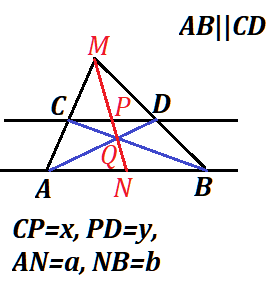
Prove that point P is a midpoint of CD and point N is a midpoint of AB.
Proof A
Let's use the symbols:
CP=x, PD=y, AN=a, MB=b.
Consider triangles
ΔAMN and ΔCMP.
They are similar because all angles are correspondingly equal.
Therefore,
x/a = MP/MN
Consider triangles
ΔBMN and ΔDMP.
They are similar because all angles are correspondingly equal.
Therefore,
y/b = MP/MN = x/a
Consider triangles
ΔCPQ and ΔBNQ.
They are similar because all angles are correspondingly equal.
Therefore,
x/b = PQ/QN
Consider triangles
ΔDPQ and ΔANQ.
They are similar because all angles are correspondingly equal.
Therefore,
y/a = PQ/QN = x/b
Now we have
y/b = x/a and
y/a = x/b
Simple algebraic transformations lead us to the following:
y·a = x·b and
y·b = x·a
All variables are positive real numbers, so we can divide the first equation by the second, canceling x and y, getting
a/b = b/a
a² = b²
a = b
From this follows
x = y
End of Proof.
Problem B
Given two parallel lines and a segment AB on one of them.
Using only a straight line ruler, divide segment AB in two equal parts.
Solution B
The solution is based on the results of Problem A above.
All we need to do is to pick up any point M, like the one on a picture above, connect it to points A and B with points C and D being the intersections of MA and MB with another parallel line.
The figure ABCD is a trapezoid, its diagonals AD and BC intersect at point Q. Line MQ with an extension to pointN bisects segments AB and CD at point N.
Problem C
Given two parallel lines and a segment AB on one of them.
Using only a straight line ruler, double the length of this segment.
In other words, find point B' on the same line where AB is located such that the length of AB equals to the length of BB'.
Solution C
First of all, pick any segment CD on another parallel line (not the one where AB is on) and divide it in half by point P, as explained in the Problem B.
Draw one line through points A and C and another through points B and P.
Assuming these line are not parallel, let M be their point of intersection (if AC||BP, choose different point D and start again.)
Line MD will cross line where segment AB is located at point B'. Segments AB and BB' will have equal lengths because CP and PD are of equal length (the proof is trivial, it follows from similarity of triangles.)
Geometry+ 09
Theorem A
Given two parallel lines, point M not on any of them and not in-between them, and two lines from this point M intersecting the given parallel lines at points A, B (on a far line), C and D (on a near line).
So, ACDB is a trapezoid.
Opposite intersection points are connected by segments AD and BC intersecting themselves at point Q.
Line connecting points M and Q intersects CD at point P and is extended to intersect AB and point N.
Prove that point P is a midpoint of CD and point N is a midpoint of AB.
Proof A
Let's use the symbols:
CP=x, PD=y, AN=a, MB=b.
Consider triangles
ΔAMN and ΔCMP.
They are similar because all angles are correspondingly equal.
Therefore,
x/a = MP/MN
Consider triangles
ΔBMN and ΔDMP.
They are similar because all angles are correspondingly equal.
Therefore,
y/b = MP/MN = x/a
Consider triangles
ΔCPQ and ΔBNQ.
They are similar because all angles are correspondingly equal.
Therefore,
x/b = PQ/QN
Consider triangles
ΔDPQ and ΔANQ.
They are similar because all angles are correspondingly equal.
Therefore,
y/a = PQ/QN = x/b
Now we have
y/b = x/a and
y/a = x/b
Simple algebraic transformations lead us to the following:
y·a = x·b and
y·b = x·a
All variables are positive real numbers, so we can divide the first equation by the second, canceling x and y, getting
a/b = b/a
a² = b²
a = b
From this follows
x = y
End of Proof.
Problem B
Given two parallel lines and a segment AB on one of them.
Using only a straight line ruler, divide segment AB in two equal parts.
Solution B
The solution is based on the results of Problem A above.
All we need to do is to pick up any point M, like the one on a picture above, connect it to points A and B with points C and D being the intersections of MA and MB with another parallel line.
The figure ABCD is a trapezoid, its diagonals AD and BC intersect at point Q. Line MQ with an extension to pointN bisects segments AB and CD at point N.
Problem C
Given two parallel lines and a segment AB on one of them.
Using only a straight line ruler, double the length of this segment.
In other words, find point B' on the same line where AB is located such that the length of AB equals to the length of BB'.
Solution C
First of all, pick any segment CD on another parallel line (not the one where AB is on) and divide it in half by point P, as explained in the Problem B.
Draw one line through points A and C and another through points B and P.
Assuming these line are not parallel, let M be their point of intersection (if AC||BP, choose different point D and start again.)
Line MD will cross line where segment AB is located at point B'. Segments AB and BB' will have equal lengths because CP and PD are of equal length (the proof is trivial, it follows from similarity of triangles.)
Monday, June 24, 2024
Arithmetic+ 09 : UNIZOR.COM - Math+ & Problems - Arithmetic
Notes to a video lecture on http://www.unizor.com
Arithmetic+ 09
Try to solve this problem without any writing, just in your head.
Problem A
A large water tank is filled to the brim.
It's capacity is unknown.
There are two pipes used to empty this tank.
If only the first pipe is open, the tank will be empty in 14 minutes.
If both pipes are open, the tank will be empty in 10 minutes.
Assume that the speed of the water flow is always constant and depends only on the pipe's diameter.
How long would it take to empty this tank, if only the second pipe is used?
Solution A
An easy way to solve this problem without pen and paper is to see how much water different pipes can let through in the same amount of time.
Let's choose a number divisible by both 14 and 10, like 70.
If a tank can be emptied through pipe #1 in 14 minutes, in 70 minutes this pipe can empty 5 tanks.
Two pipes can let through the water of one tank in 10 minutes. Therefore, in 70 minutes two pipes can empty 7 tanks of water.
So, the pipe #1 in 70 minutes can empty 5 tanks. Both pipes in the same amount of time (70 minutes) can empty 7 tanks of water. Therefore, pipe #2 alone in 70 minutes can empty 7−5=2 tanks of water.
Therefore, one tank the pipe #2 can empty in 70/2=35 minutes.
Answer A
The second pipe can empty the tank in 35 minutes.
Problem B
Mike and David felt like having an ice cream for lunch.
However, it appeared that Mike is short on money. He needed $3 more to buy a single scoop of ice cream.
David looked at his money and it appeared that he is also short by $1 to buy a single scoop of ice cream.
Then they thought to combine their amounts and buy only one scoop to share. Unfortunately, the total was insufficient for a single scoop even then.
How much (in whole dollars) does a scoop of ice cream cost?
Solution B
If Mike had, at least, $1 in his pocket, combined with David's money (who was short by $1), they would be able to buy a scoop of ice cream.
Since they were short even combining their money, Mike's capital was zero dollars.
Therefore, since he was short by $3, the price of a scoop of ice cream was $3.
Answer B
A scoop of ice cream costs $3.
Problem C
There are circles and squares drawn on a sheet of paper.
Some of them are red, the other are blue.
The number of red circles is equal to the number of blue squares.
What is greater, the number of red shapes or the number of squares?
Solution C
The number of red shapes equals to the number of red squares plus the number of red circles.
The number of squares equals to the number of red squares plus the number of blue squares.
The first term of each statement above ("red squares") is the same.
The second term in the first statement ("red circles") equals to the second term in the second statement ("blue squares"). Therefore, the number of red shapes equals to the number of squares.
Answer C
The number of red shapes is equal to the number of squares.
Arithmetic+ 09
Try to solve this problem without any writing, just in your head.
Problem A
A large water tank is filled to the brim.
It's capacity is unknown.
There are two pipes used to empty this tank.
If only the first pipe is open, the tank will be empty in 14 minutes.
If both pipes are open, the tank will be empty in 10 minutes.
Assume that the speed of the water flow is always constant and depends only on the pipe's diameter.
How long would it take to empty this tank, if only the second pipe is used?
Solution A
An easy way to solve this problem without pen and paper is to see how much water different pipes can let through in the same amount of time.
Let's choose a number divisible by both 14 and 10, like 70.
If a tank can be emptied through pipe #1 in 14 minutes, in 70 minutes this pipe can empty 5 tanks.
Two pipes can let through the water of one tank in 10 minutes. Therefore, in 70 minutes two pipes can empty 7 tanks of water.
So, the pipe #1 in 70 minutes can empty 5 tanks. Both pipes in the same amount of time (70 minutes) can empty 7 tanks of water. Therefore, pipe #2 alone in 70 minutes can empty 7−5=2 tanks of water.
Therefore, one tank the pipe #2 can empty in 70/2=35 minutes.
Answer A
The second pipe can empty the tank in 35 minutes.
Problem B
Mike and David felt like having an ice cream for lunch.
However, it appeared that Mike is short on money. He needed $3 more to buy a single scoop of ice cream.
David looked at his money and it appeared that he is also short by $1 to buy a single scoop of ice cream.
Then they thought to combine their amounts and buy only one scoop to share. Unfortunately, the total was insufficient for a single scoop even then.
How much (in whole dollars) does a scoop of ice cream cost?
Solution B
If Mike had, at least, $1 in his pocket, combined with David's money (who was short by $1), they would be able to buy a scoop of ice cream.
Since they were short even combining their money, Mike's capital was zero dollars.
Therefore, since he was short by $3, the price of a scoop of ice cream was $3.
Answer B
A scoop of ice cream costs $3.
Problem C
There are circles and squares drawn on a sheet of paper.
Some of them are red, the other are blue.
The number of red circles is equal to the number of blue squares.
What is greater, the number of red shapes or the number of squares?
Solution C
The number of red shapes equals to the number of red squares plus the number of red circles.
The number of squares equals to the number of red squares plus the number of blue squares.
The first term of each statement above ("red squares") is the same.
The second term in the first statement ("red circles") equals to the second term in the second statement ("blue squares"). Therefore, the number of red shapes equals to the number of squares.
Answer C
The number of red shapes is equal to the number of squares.
Sunday, June 23, 2024
Arithmetic+ 08: UNIZOR.COM - Math+ & Problems - Arithmetic
Notes to a video lecture on http://www.unizor.com
Arithmetic+ 08
Try to solve this problem without any writing, just in your head.
Problem A
There are certain number of students in the class and certain number of desks.
If 2 students sit at a desk, 5 desks will remain unoccupied.
If 1 student sits at a desk, 5 students will have no place to sit at.
How many students should sit by 2 at the desk and how many should sit by 1 at the desk, so all students will have seats and all desks occupied?
Solution A
If a single seating arrangement results in 5 students without a desk, we can put these students as doubles, which results in a combination of 5 doubles plus unknown singles needed to occupy all desks.
If double seating results in 5 desks unoccupied, let's convert 5 doubles into singles to have 5 students to occupy previously unoccupied 5 desks. Then the number of singles will be 10 (5 doubles converted into singles and 5 previously unoccupied desks having only one student each).
So, to occupy all desks with double or single we should use 5 doubles and 10 singles.
Incidentally, it makes the number of desks 15 and the number of students 20.
Answer A
5 desks should accommodate two students each and 10 desks should sit single student each.
Problem B
A large water tank is filled to the brim.
It's capacity is unknown.
There are two pipes used to empty this tank.
If only the first pipe is open, the tank will be empty in 14 minutes.
If both pipes are open, the tank will be empty in 10 minutes.
Assume that the speed of the water flow is always constant and depends only on the pipe's diameter.
How long would it take to empty this tank, if only the second pipe is used?
Solution B
An easy way to solve this problem without pen and paper is to see how much water different pipes can let through in the same amount of time.
Let's choose a number divisible by both 14 and 10, like 70.
If a tank can be emptied through pipe #1 in 14 minutes, in 70 minutes this pipe can empty 5 tanks.
Two pipes can let through the water of one tank in 10 minutes. Therefore, in 70 minutes two pipes can empty 7 tanks of water.
So, the pipe #1 in 70 minutes can empty 5 tanks. Both pipes in the same amount of time (70 minutes) can empty 7 tanks of water. Therefore, pipe #2 alone in 70 minutes can empty 7−5=2 tanks of water.
Therefore, one tank the pipe #2 can empty in 70/2=35 minutes.
Arithmetic+ 08
Try to solve this problem without any writing, just in your head.
Problem A
There are certain number of students in the class and certain number of desks.
If 2 students sit at a desk, 5 desks will remain unoccupied.
If 1 student sits at a desk, 5 students will have no place to sit at.
How many students should sit by 2 at the desk and how many should sit by 1 at the desk, so all students will have seats and all desks occupied?
Solution A
If a single seating arrangement results in 5 students without a desk, we can put these students as doubles, which results in a combination of 5 doubles plus unknown singles needed to occupy all desks.
If double seating results in 5 desks unoccupied, let's convert 5 doubles into singles to have 5 students to occupy previously unoccupied 5 desks. Then the number of singles will be 10 (5 doubles converted into singles and 5 previously unoccupied desks having only one student each).
So, to occupy all desks with double or single we should use 5 doubles and 10 singles.
Incidentally, it makes the number of desks 15 and the number of students 20.
Answer A
5 desks should accommodate two students each and 10 desks should sit single student each.
Problem B
A large water tank is filled to the brim.
It's capacity is unknown.
There are two pipes used to empty this tank.
If only the first pipe is open, the tank will be empty in 14 minutes.
If both pipes are open, the tank will be empty in 10 minutes.
Assume that the speed of the water flow is always constant and depends only on the pipe's diameter.
How long would it take to empty this tank, if only the second pipe is used?
Solution B
An easy way to solve this problem without pen and paper is to see how much water different pipes can let through in the same amount of time.
Let's choose a number divisible by both 14 and 10, like 70.
If a tank can be emptied through pipe #1 in 14 minutes, in 70 minutes this pipe can empty 5 tanks.
Two pipes can let through the water of one tank in 10 minutes. Therefore, in 70 minutes two pipes can empty 7 tanks of water.
So, the pipe #1 in 70 minutes can empty 5 tanks. Both pipes in the same amount of time (70 minutes) can empty 7 tanks of water. Therefore, pipe #2 alone in 70 minutes can empty 7−5=2 tanks of water.
Therefore, one tank the pipe #2 can empty in 70/2=35 minutes.
Logic+ 11: UNIZOR.COM - Math+ & Problems - Logic
Notes to a video lecture on http://www.unizor.com
Logic+ 11
Problem A
During an epidemic people tried to sit as far from each other as possible.
Consider a row of 11 seats.
Maximum number of people to accommodate in these seats, so that none sits next to another and there is only one empty seat between people is 6:
I-I-I-I-I-I,
where 'I' signifies a seat taken by a person and '-' is an empty seat.
Considering every new person takes a seat as far as possible from those who already sit, where would you put the first person to be able to sit the maximum number of people?
Hint
If you put the first person at the left or the right edge of a row, or right in the middle, you will not be able to accommodate 6 people.
Here is an example:
I----------,
I---------I,
I----I----I,
and the next person would inevitably leave 2 empty seats in a row, which would prohibit the 6th person to sit without another person sitting next to him.
Solution A
To reach the maximum occupancy of 6 people without anyone sitting next to another, that is to reach configuration
I-I-I-I-I-I,
the configuration after 3 people have taken their seat should be
I---I---I-- or --I---I---I,
because that would force the next 3 people to take seats in-between the already taken with one empty seat between them.
Then the previous configuration after 2 people have taken their seat should be
I-------I-- or --I-------I,
because the 3rd person, taking the seat as far from those taken, would bring the configuration to the one above.
Therefore, the first person should take either the seat #9 or #3 to get the configuration
--------I-- or --I--------,
which would lead to all the above configurations step-by-step.
Answer
To reach the maximum number of people to sit on 11 seats without them being next to another, start from pointing to seats #3 or #9.
Then the sequence of fillings of the seats would be
--------I-- or --I--------,
I-------I-- or --I-------I,
I---I---I-- or --I---I---I,
which leaves 3 empty seats for the next 3 people exactly in-between already taken ones, leaving an empty seat between people.
Logic+ 11
Problem A
During an epidemic people tried to sit as far from each other as possible.
Consider a row of 11 seats.
Maximum number of people to accommodate in these seats, so that none sits next to another and there is only one empty seat between people is 6:
I-I-I-I-I-I,
where 'I' signifies a seat taken by a person and '-' is an empty seat.
Considering every new person takes a seat as far as possible from those who already sit, where would you put the first person to be able to sit the maximum number of people?
Hint
If you put the first person at the left or the right edge of a row, or right in the middle, you will not be able to accommodate 6 people.
Here is an example:
I----------,
I---------I,
I----I----I,
and the next person would inevitably leave 2 empty seats in a row, which would prohibit the 6th person to sit without another person sitting next to him.
Solution A
To reach the maximum occupancy of 6 people without anyone sitting next to another, that is to reach configuration
I-I-I-I-I-I,
the configuration after 3 people have taken their seat should be
I---I---I-- or --I---I---I,
because that would force the next 3 people to take seats in-between the already taken with one empty seat between them.
Then the previous configuration after 2 people have taken their seat should be
I-------I-- or --I-------I,
because the 3rd person, taking the seat as far from those taken, would bring the configuration to the one above.
Therefore, the first person should take either the seat #9 or #3 to get the configuration
--------I-- or --I--------,
which would lead to all the above configurations step-by-step.
Answer
To reach the maximum number of people to sit on 11 seats without them being next to another, start from pointing to seats #3 or #9.
Then the sequence of fillings of the seats would be
--------I-- or --I--------,
I-------I-- or --I-------I,
I---I---I-- or --I---I---I,
which leaves 3 empty seats for the next 3 people exactly in-between already taken ones, leaving an empty seat between people.
Subscribe to:
Posts (Atom)

